Attraction is often treated as a mystery. Something irrational. Something that just happens.
Yet many people notice a pattern: they are drawn to similar people, fall into similar dynamics, and encounter the same tensions across different relationships.
This suggests attraction is not random — but structured.
What This Model Is — And Is Not
Attraction Archetypes does not describe intelligence, values, moral character, or professional strengths.
It describes how you naturally create intimacy, what kind of role feels energizing and authentic, and what kind of dynamic generates attraction, tension, or friction.
Not who you are in general — but who you become with someone else.
The Four Axes of Attraction
The model is built on four independent axes. They describe preferences, not fixed behavior.
1) Leading ↔ Receiving (L / R)
Do you naturally initiate, guide, and set direction — or respond, attune, and receive?
2) Intensive ↔ Unhurried (I / U)
Does closeness feel best when it is focused, charged, and immersive — or slow, spacious, and allowed to unfold?
3) Familiar ↔ Curious (F / C)
Do you prefer depth through repetition and safety — or through novelty and discovery?
4) Emotional ↔ Instinctive (E / I)
Is intimacy primarily processed through emotional meaning and connection — or through physical sensation and instinct?
Each axis reflects what feels right, not what is expected.
From Axes to Archetypes
Combining these four axes produces 16 recurring intimacy archetypes.
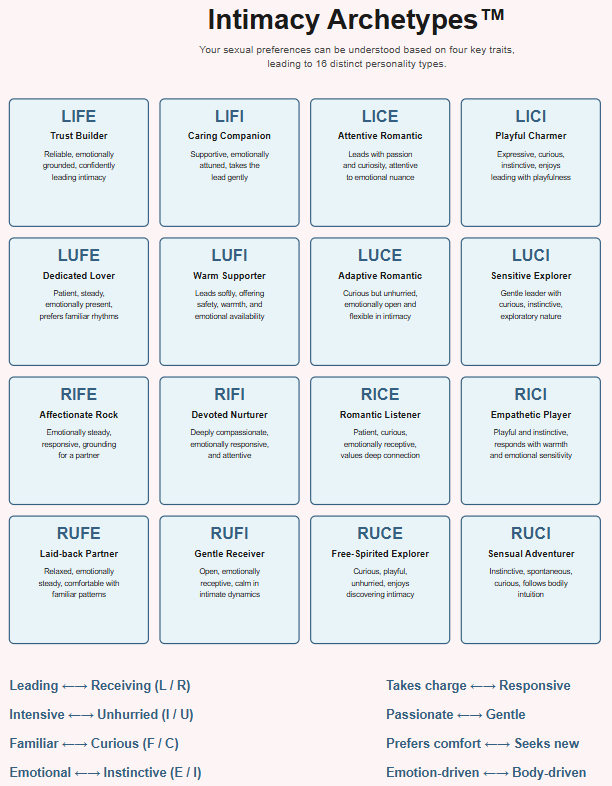
Each archetype represents a distinct way of creating closeness: initiating or receiving intimacy, regulating pace and intensity, relating to familiarity and novelty, and experiencing desire emotionally or instinctively.
Why Attraction Feels Effortless — Or Draining
When two archetypes meet, three outcomes are common:
- Natural flow — roles complement each other, pace aligns, intimacy feels easy.
- Magnetic tension — strong attraction exists, but requires awareness to remain sustainable.
- Chronic friction — no one is wrong, yet the dynamic repeatedly drains energy.
The key insight is simple: compatibility is about dynamics, not similarity.
How This Differs from Personality Models
Most personality models explain how you think, decide, and behave across contexts.
Attraction Archetypes explains where attraction comes from, why certain relational patterns repeat, and why chemistry can exist without safety — or safety without desire.
It makes the invisible structure of intimacy visible.
What This Model Is Useful For
- Understanding why certain people feel instantly right or wrong
- Identifying repeating relationship dynamics
- Separating personal worth from relational fit
- Reducing shame around preference and desire
Often the relief comes from realizing: nothing is broken — the dynamic simply does not match.
Attraction may never be fully controllable. But it is far more understandable than we are usually taught.